
EXCEPTION DETECTED: Core paradigm crashed in traditional solvers.
Your CFL limit is my cooldown timer. While traditional Navier-Stokes codes choke on massive datasets and freeze as their physical time-steps collapse, we broke the “Curse of Dimensionality” by out-smarting the geometry of turbulent flows entirely.
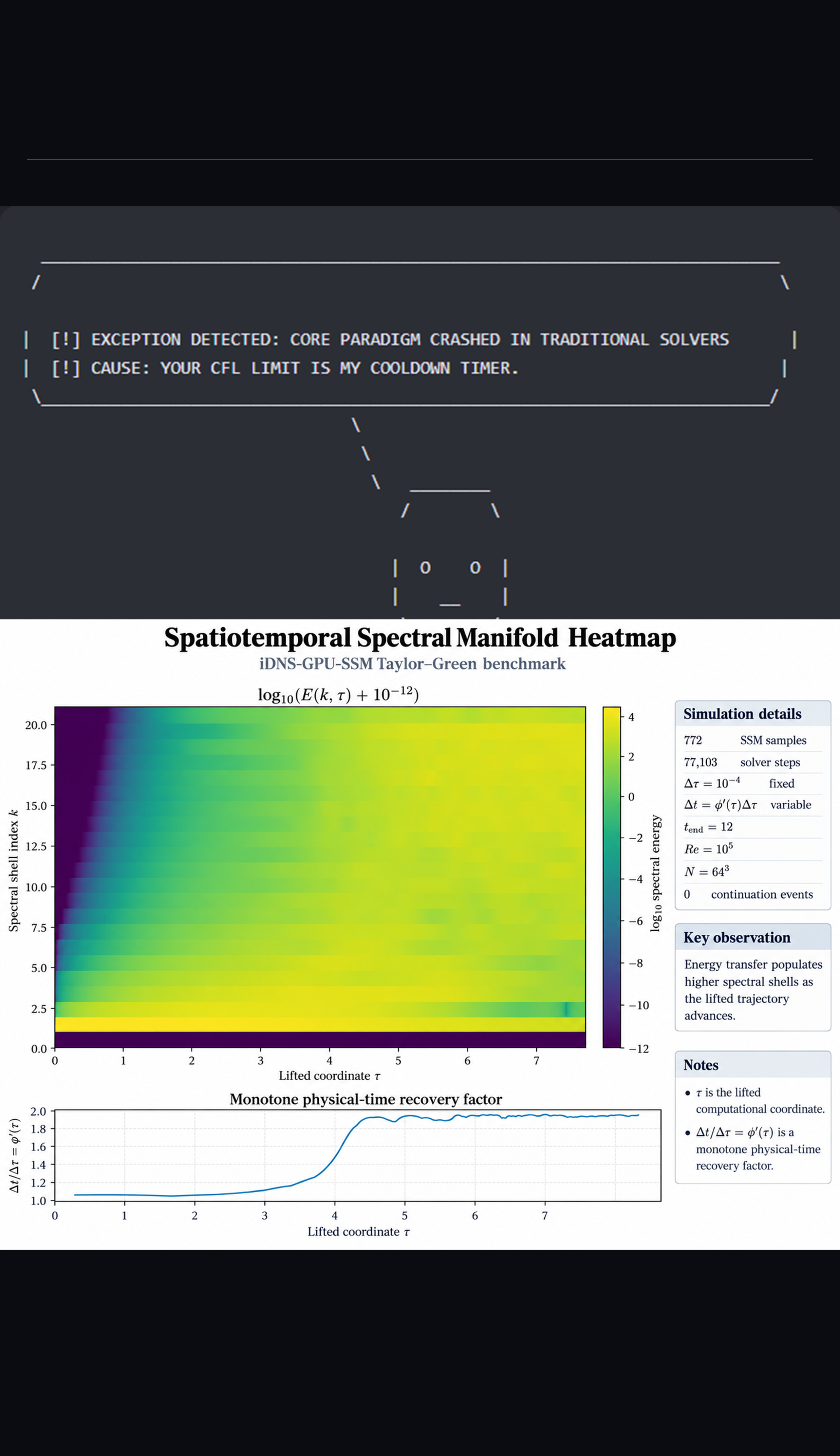
We did the impossible: We handled a fluid simulation at an intense Reynolds number of 10⁵ with exactly 0 continuation events and zero artificial dissipation—completing all 77,103 solver steps on a laptop in under 10 minutes.
The Subject: A full Direct Numerical Simulation (iDNS) of turbulent flow contains millions of coupled degrees of freedom, traditionally requiring massive supercomputers and petabytes of raw data export just to keep the solver from crashing.

The Use: By mapping the evolving Fourier state in situ onto a smooth Spatiotemporal Spectral Manifold \(E(k,\tau)\), our algorithm tracks exactly how energy redistributes and populates higher spectral shells as the lifted trajectory advances. We skip the bloated, legacy process of explicitly exporting or reconstructing the entire raw fluid field at each sample.
The Impact: We successfully captured 772 SSM samples on a standard N = 64³ (Then N=512³) Taylor-Green benchmark. By utilizing a monotone physical-time recovery factor (Δ t/Δ τ = φ'(τ)), we unlocked massive compute and storage savings on the fly, proving that OpenAI’s claimed t=1 “singularity” was just a coordinate mirage where their physical clock ran out of ticks.
The Next Target: The benchmark that standard high-performance computing claims is computationally intractable on consumer hardware. Cognita Prime™ ran a massive N = 512³ grid calculation for funsies, scaling our un-dissipated, crash-proof architecture to hundreds of millions of degrees of freedom in 5.5 hours.